
I’ve coached founders and executives at:
Founder coaching for the AI era.
For founders whose company has outgrown the way they used to lead. Especially the CEO and CTO building an AI company together, and the calls they have to make as a pair.
Make hard decisions faster. Have the conversation you've been avoiding. Build a leadership team that carries the company with you.
If someone sent you here, you've probably heard a little about how I work. Here's the rest, plainly.
I coach CEOs and CTOs, and the working relationship between them, through the stretch where the company gets bigger than their experience. I can coach each of you and, when it helps, both of you together. I've founded three venture-backed companies. I'm based in New York and work with founders in person here and remotely anywhere. I was a Reboot coach for three years, helped launch their Circles group coaching product, and ran their longest-running, highest-NPS circle. I've practiced meditation for twenty years, and I build with AI tools myself.
The first conversation is free.
Coaching since 2018 · Over a hundred clients · Thousands of coaching hours · Clients' companies have raised $3.9 billion · Founders and executives at seven companies that reached unicorn valuations · Six client companies acquired since 2024
As of October 2026.

"He helped me clarify what mattered most and pressure-test tradeoffs. The result was faster alignment, better trust with stakeholders, and a cleaner path forward when the build is hard and lonely."

Vince Lynch, CEO, IV.AI
The company changes. Your job changes with it.
You used to know where you were useful. You built the product, sat with customers, and shipped the thing.
Now a good day might mean letting someone else make the call, telling an executive something neither of you wants to hear, or picking a direction before you have enough information to feel good about it.
Meanwhile the calendar is full, your actual thinking happens at night, and the issue you avoided last quarter is still taking up space.
You can be very good at building a company and still find this part hard. Some of the habits that got you here, like sweating every detail, making every call, and outworking the problem, start getting in the way.
That's where we work.
What this is, and what it isn't
It isn't therapy, though we'll talk about more than the org chart. It isn't a peer group, where everyone is at the same stage and the conversations stay polite.
It's a long, private conversation with someone who has built companies and knows what the founder seat is like from the inside. I'll ask hard questions, tell you what I notice, and stay with the subject until something is clearer than when we started.
Founders usually come in with a specific problem and a few bigger questions underneath it. Am I actually good at this? What do I stop doing, what do I keep, and what has to change? How do I stay present with the people at home while the company takes everything I give it?
We work on both.
What we work on
We start with what's happening in your company and what you need to do about it. It usually looks like one of these.
"How do I say this to my cofounder?"
The CEO and CTO partnership is the core leadership system of a technical company, and it gets renegotiated every time the company grows. Who decides what across product, technology, and the business keeps shifting. You keep reopening the same decision. A disagreement about the roadmap has become a disagreement about trust. We get specific about what's happening, who owns which calls, what you need to say, and how to say it. You can practice the conversation here before you have it. If you both want it, we can work on this together, not only one side at a time.
"Are we doing too many things?"
You have a long strategy document and a team that still can't tell you what matters most. We work through the tradeoffs until you can name the priorities, assign ownership, and be explicit about what you're not doing.
"Why am I still involved in everything?"
You've delegated responsibility, but everyone still waits for your approval. Or you hand something off and take it back when it isn't done your way. We look at expectations, ownership, and your part in the pattern. Then you practice giving someone room to do the job.
"Do I have the right people in the right roles?"
Your strongest engineer is now managing people, and it isn't working. You need an executive hire but haven't defined what they should own. We clarify the job, the performance you need, and the conversation you owe the person.
"Why does every board meeting feel like a performance?"
We work on a clear account of the business, the decisions ahead, and the help you need. Bring the deck. We'll work through the story and rehearse the hard questions.
"How do I keep doing this?"
You're reacting faster and thinking less. Bad news follows you home. We look at what's driving the pressure, how you respond to it, and what needs to change, at work and at home. Your ambition matters. So does the person carrying it.
"Tarikh pushed me to get clear on strategy, lead through ambiguity, and balance people, product, and execution without burning myself out."

Felipe Baytelman, cofounder and CTO, Noken
What I bring to the work
Operating experience, coaching craft, and twenty years of meditation practice. We start with the issue that brought you here, including the part you've been reluctant to say out loud. We start at full depth from session one and achieve tangible growth by session six.
I've built companies, and I'm still building. I've founded three venture-backed startups (Seen, Katch and RMX Party), raised capital, and grown a product to more than a million monthly users within nine months. I've led teams through pivots, layoffs, shutdowns, and exits. I know how much of yourself can get wrapped up in what you're building.
I also run Superculture, where I help businesses choose and implement AI systems. This coaching practice is a different engagement: here, we work on how you lead. I build with these tools now. I use Claude Code and Codex, and I created Ed Bot 2.0 with Ed Batista, a coaching agent grounded in twenty years of his writing. That keeps me close to what my clients are living with: the possibilities, the frustrations, the pace, and the plan that stops making sense after the next model release.
It also makes me clear about what a model can't do for you. You can rehearse a conversation with one. It won't notice that you changed the subject when your cofounder came up.
I've spent years learning the craft of coaching: thousands of hours, with over a hundred clients. I'm an ICF PCC. I was a Reboot coach for three years, helped launch their Circles group coaching product, and ran their longest-running, highest-NPS circle. The craft shows up in the conversation: a precise question, a challenge to an explanation that doesn't hold up, or noticing that we've spent twenty minutes on everyone's behavior except yours.
We can work on the org chart and on why you're reluctant to change it. Both matter.
I pay attention to what's underneath the explanation. Sometimes you know what you need to do and keep finding reasons not to do it. Sometimes the story you're telling leaves out the most important part. My job is to listen closely, tell you what I notice, and help you decide what to do with it.

Meditation, used as attention training.
I've practiced meditation for twenty years, and it's still a daily practice. I'm an IMTA Certified Mindfulness Teacher.
I don't bring it into coaching as healing or as something spiritual you have to sign up for. I treat it as training. It's practice in noticing where your attention goes, staying steady when you don't have enough information, and catching a reaction before it turns into a decision.
In a session, that looks ordinary. I might catch the explanation you've given three times and ask what it leaves out. I might notice how quickly certainty arrives when a subject gets uncomfortable. Sometimes we stay with a hard moment long enough for you to say the true thing instead of the smooth one.
I've explored meditation and its relationship to work and life in conversations with Sharon Salzberg, Pixar cofounder Ed Catmull, and former Pixar CFO Lawrence Levy. Those conversations are part of a longer inquiry into how we build ambitious things and how we treat ourselves and other people along the way. I'm also quoted in Sharon Salzberg's Real Happiness at Work (Workman, 2013).
I'm still practicing with those questions myself, most mornings, before the day gets loud.
"Tarikh is the Rick Rubin of coaching: brilliant, supportive, demanding."
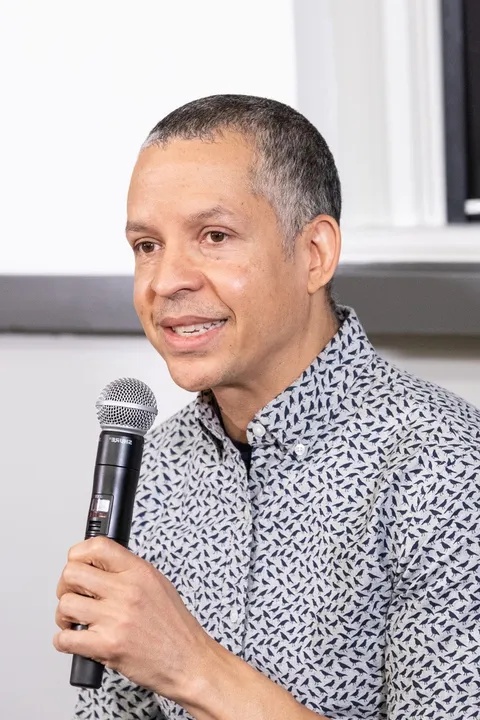
Saadiq Rodgers-King, cofounder, Hot Potato
(acquired by Facebook)
How it works
We start by talking. The first conversation is with me. We'll discuss your situation, what you want from coaching, and whether my experience and approach fit what you need. There's no charge.
Coaching is month to month. We open with a longer intake to understand the company, the people, and the pressure points, and we agree on two or three priorities. Those are what we measure against.
Regular sessions, grounded in what's happening. Two to four a month, 60 to 90 minutes, on video or in person in New York. Bring the cofounder issue, the hiring decision, the strategy question, or the thing you haven't said out loud yet.
Between sessions, you can reach me for the things that can't wait: a draft of a tough message, a perspective check before a board call, a debrief after a hard conversation.
Every few months we look at what changed. What did you do differently? What does the evidence say? What are you still avoiding? You can stop any month.
Cofounders together. I coach each cofounder on their own and, when it helps, both of you together, on how you divide decisions, address conflict, and work together.
Investment. $3,000 to $6,000 a month, depending on how often we meet (two to four sessions a month) and session length (60 to 90 minutes). It's a monthly retainer on a sliding scale, month to month, with no upfront payment, and a few reduced-rate spots. A cofounder pair pays one fee, not one each, and the work is scoped together on a call. The full breakdown is on the coaching cost page.
Tell me what's actually happening.
You don't need a polished explanation. Bring the decision you keep circling, the relationship that's getting harder, or the sense that your job changed and you're still catching up.
If someone pointed you here, tell me who. It helps me understand what you've already heard.
We'll talk about where you are, what you want from this, and whether working together makes sense. I read every message and reply myself.
Book a 30-minute intro callThe first conversation is free.