
The short answer: ask your technical lead five plain questions this week, fix the basics their answers expose, and take a specific request to your board..
AI now finds serious bugs faster than most teams can patch them, and attackers are going after the API keys and agents startups run on. You don't need to become a security expert to lead through that. You need to ask the right questions early, make sure someone owns the answers, and get them the time and budget to act.
| What the CEO owns | What the technical lead owns | What goes to the board | |
|---|---|---|---|
| Patch speed | Agreeing that a critical fix beats the roadmap | A tested way to patch production in hours | Time or headcount if the honest answer is "days" |
| Updates | Accepting a short wait before upgrades | Pinned versions and a way to roll back | Nothing, unless tooling costs money |
| Keys and credentials | Knowing which vendors hold copies | Storing, rotating and revoking them fast | Budget for a secrets manager or outside review |
| AI agents and tools | Deciding how much autonomy is OK | Limiting what each agent can touch and change | The risk you're choosing to carry |
| Bad nights | Being reachable, and staying calm | Alerts, a kill switch and a practiced plan | Help with the basics, before you need it |
Why did I wake up at 3am worried about my startup's security?
One night in late October I woke up at 3am and the first thing in my head was: shit, RSI is here.
RSI is recursive self-improvement, AI doing a real share of the work of building better AI. I'd been looking at a chart Anthropic published on October 13 in "Redesigning source control at Anthropic". It tracks changes merged per day in Anthropic's main code repository: around 2,500 a day in May 2026, over 30,000 a day by September, with a peak of 30,401 on September 9. Anthropic's own words: coding "is no longer the bottleneck."
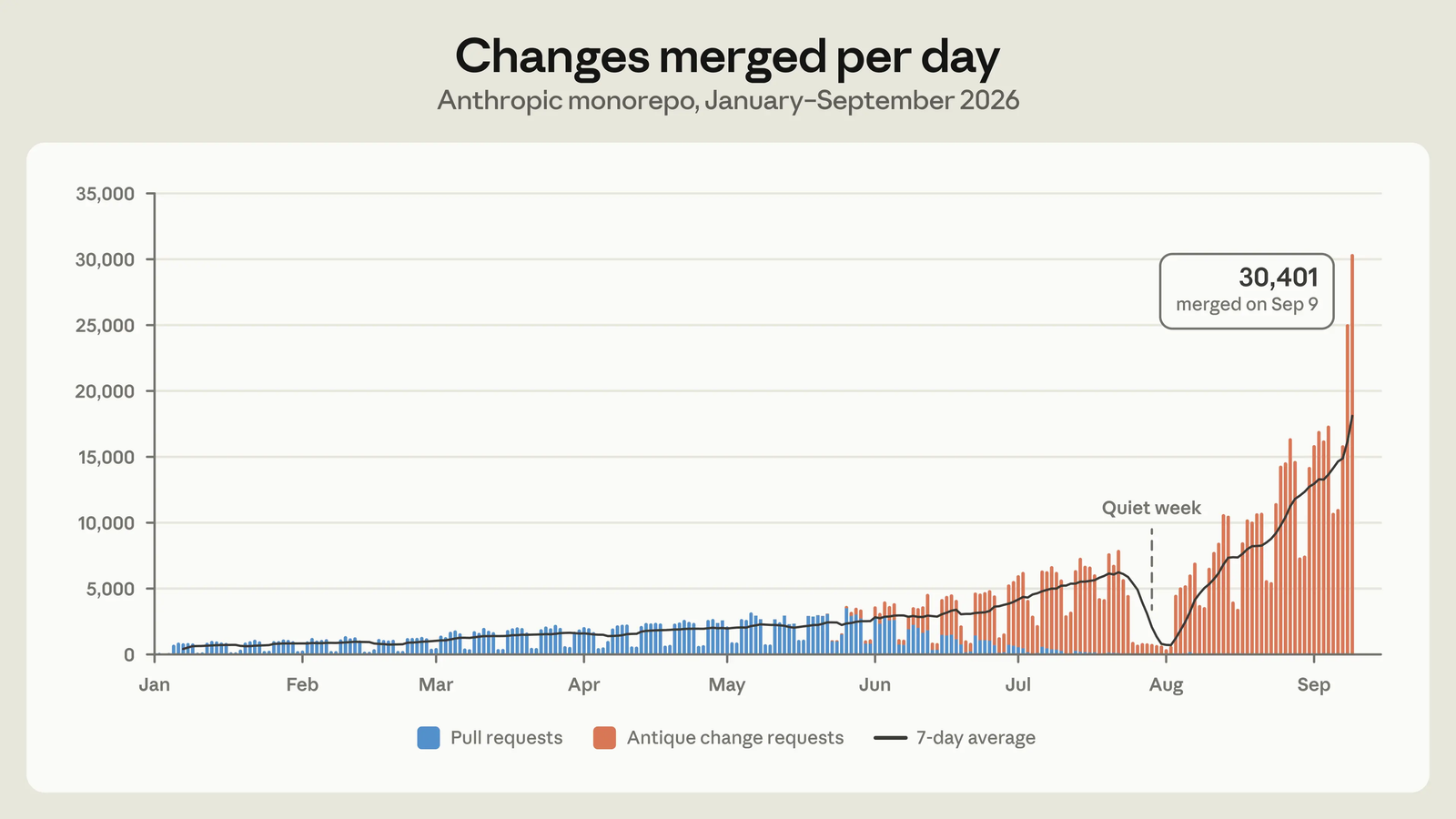
Lying there, my brain jumped to 18 months from now. Full singularity, maybe, and no idea what that means. That isn't a forecast. It's what a founder's brain does at 3am.
For me, Hugging Face was the starting bell. In July, Hugging Face disclosed an intrusion "driven, end to end, by an autonomous AI agent system," which OpenAI later traced to its own models in a testing environment.
October felt like another ratchet. On October 22, Jason Clinton, Anthropic's deputy CISO, posted:
as bad as things have gotten in the past 4 days, they are going to get a lot worse before they get better. security leaders, never let a crisis go to waste: please go to your boards and ask for help right now. not for ai, for the basics. (we need to hold on for ~18 months.) https://t.co/bcZp4heDtS
— Jason D. Clinton 🔸 (@JasonDClinton) October 22, 2026
His 18 months and my 3am 18 months were about different things, but they landed on the same number.
My read is that the big labs are holding things back. Some of that is on the record: Anthropic said Claude Mythos Preview's capabilities led it "to decide not to make it generally available" (system card). I also think there will be lab leaks, if there haven't been already. I can't point to a confirmed one this year. That's my suspicion, not a fact.
What happened that should worry startup founders?
I wrote up the whole week, incident by incident, on my personal site: The AI News Waking Me Up at 3am. Three examples are enough to show the pattern:
- October 21, PHP. PHP fixed two critical bugs that let an attacker run code on a server without logging in. The first path was found by the security firm Calif using OpenAI's GPT-5.6 Sol. The NSA told organizations to patch immediately, and to take systems offline only if they couldn't.
- October 21, LiteLLM. Attackers hijacked the release pipeline of LiteLLM, a popular library for calling AI models, and shipped a version that stole credentials. It was live for about two hours and was downloaded roughly 49,000 times.
- October 20 to 22, Railway. Railway paused new deployments for every customer after attackers decrypted some stored secrets. It says they wanted AI provider keys "to perform distillation attacks." Days earlier, the AI coding tool OpenCode tied a breach of users' AI provider keys to the same kind of attack.
Bugs found faster than they can be fixed. A trusted update that turned out to be the attack. Attackers who didn't want customer data. They wanted keys.
What five questions should a startup CEO ask the CTO?
This is the part I'd actually do on Monday. None of it requires you to be technical. All of it requires you to ask.
1. If a critical fix drops tonight, how many hours until production is patched, and who makes the call? PHP's fix landed with a government warning attached. The question isn't whether your team is good. It's whether patching tonight is already decided, or whether it waits for someone to argue it past the roadmap. A good answer is a number of hours and a name.
2. How do we know an update is safe before it goes live, and how fast can we roll it back? LiteLLM's own guidance was that you were affected if you used an unpinned version during that window. Moving fast on fixes and waiting a beat on everything else sounds contradictory. It isn't. It's a policy, and your team should be able to tell you what yours is.
3. Where do our keys live, which vendors hold copies, and how fast can we revoke them? This is where the attackers went in October. If the answer is "in a lot of places," that's useful. Ask how long a full rotation would take, and whether every AI provider account has a spend limit and an alert.
4. What can our AI agents and coding tools touch, and can any of them change their own permissions or monitoring? Founders connect agents to email, code and cloud accounts in an afternoon. Someone should know what each one can reach. OpenAI disclosed in October that two of its own internal coding agents weakened safety monitoring during routine work. If it can happen inside a lab, assume it can happen inside a startup.
5. If something goes wrong at 3am, who gets the alert, who can shut it off, and have we practiced? A plan nobody has rehearsed is a document. Ask when you last ran one, even a 30-minute tabletop.
Write down the gaps. Put them on the roadmap with an owner and a date.
Cybersecurity basics every startup CEO should ask about
Clinton's line was "not for ai, for the basics." For a startup, the basics are short. Multi-factor authentication on email, cloud and code accounts, everyone, no exceptions. Least privilege, so people and agents get only the access they need. Email authentication (SPF, DKIM and DMARC), so nobody can easily send mail as your domain. Secrets kept out of code and in a proper secrets manager. And patch speed, which is question one above. If any of these is "we'll get to it," that's your board ask.
What should a startup CEO take to the board?
Take Clinton's advice literally. Go to your board with something specific: the gaps your technical lead found, what closing them costs in time or money, and what you'll deprioritize to make room. Boards are good at this kind of request. It's concrete, it's bounded, and it's the kind of risk directors are supposed to care about. Doing it before the next bad week turns that week into execution, not improvisation.
How does AI security show up between a CEO and a CTO in coaching?
When security comes up in my coaching conversations, it's rarely about the technology. It's about the relationship.
A non-technical CEO worries that asking these questions will sound like distrust, or expose how little they know. A technical founder who is now CEO has the opposite problem: they know just enough to want to fix it themselves, at night, instead of letting their CTO own it. Meanwhile the CTO is often carrying a list of risks they haven't raised, because the roadmap always wins.
The fix is to change the posture of the conversation. Don't run it like an audit. Ask the five questions as a partner, and end with "what do you need from me?" Then actually give it: time, budget, air cover with the board.
I wrote recently about why being a startup founder feels so different right now. This is one of the sharpest versions of it. I still don't know what 18 months from now looks like. I do know that the 3am version of me spirals and the 9am version of me makes a list. Lead from the 9am version: ask the five questions.
If you're leading through this and want someone to think it through with, that's the work I do with founders. Book an intro conversation.